 There are times when a client’s experience explains more about a condition than any clinical definition ever could.
Recently, actress and comedian Bryony Twydle spoke publicly about living with emetophobia, her experience of pregnancy, and a decision that she feared other people would judge her for.
Her story appeared in The Sun newspaper under a stark headline about terminating a wanted pregnancy because she was so frightened of morning sickness. Behind that headline is a much more complicated story about what severe emetophobia can actually do to someone’s life.
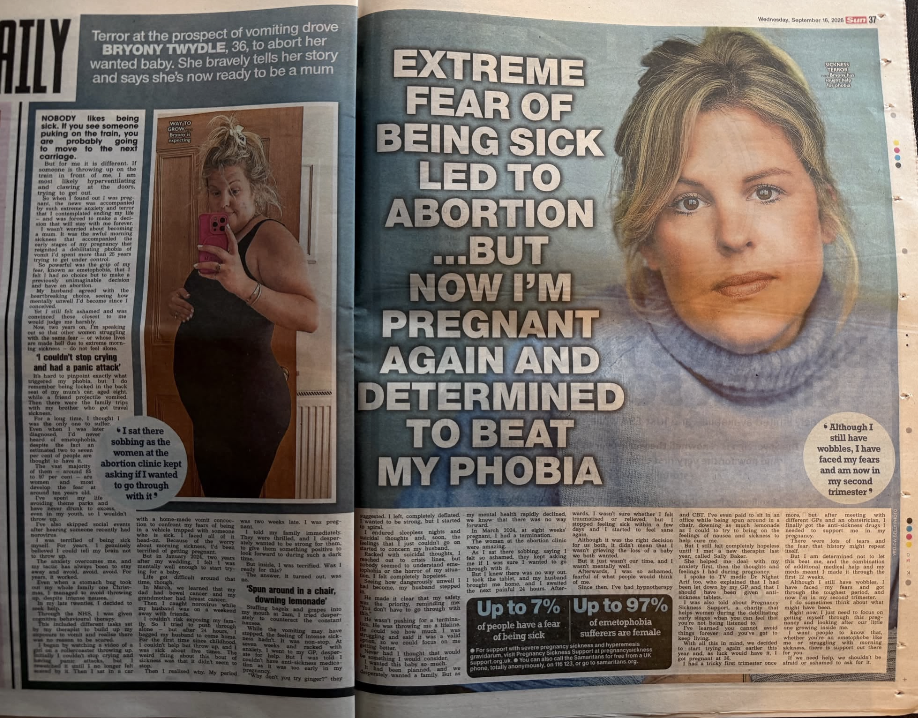
I know Bryony because I worked with her therapeutically. I am sharing and discussing her story here because Bryony has chosen to speak publicly about both her experience and our work together. Her account illustrates something I have been saying for a long time: severe emetophobia is not adequately described as simply being frightened of vomiting. For some people it becomes an organising principle for their lives.
It can influence where they go, what they eat, how they travel, whether they drink alcohol, how they respond to illness, how safe they feel around children and, for some women, how they feel about pregnancy.
Bryony’s experience demonstrates just how serious that can become.
What is emetophobia?
Emetophobia is usually described as an extreme fear of vomiting, seeing someone vomit, feeling nauseous or being in a situation where vomiting might happen. That definition is accurate, but it does not really convey what I see in my therapy room. People with severe emetophobia can become extraordinarily vigilant about bodily sensations. A perfectly ordinary feeling in the stomach can be noticed, monitored and interpreted as evidence that something is wrong. Am I feeling sick? Why does my stomach feel strange? What did I eat? Was that food safe? Has somebody near me been ill? Could I have caught something? What if I am sick and cannot stop?
The attempt to prevent vomiting can gradually become almost as debilitating as the anxiety itself. People avoid foods. They check dates. They monitor other people. They avoid public transport, restaurants, alcohol, hospitals, aeroplanes or anyone who has recently had a stomach bug. Avoidance makes sense when you understand what the nervous system is trying to achieve. It is attempting to keep the person safe. The problem is that every successful avoidance can reinforce the message that something dangerous really existed to escape.
Pregnancy can change the landscape completely
Pregnancy presents a particular challenge for someone with emetophobia because many of the things they have spent years trying to control suddenly become much less controllable.
Nausea is common during early pregnancy. The body feels different. Appetite can change. Smells can become extraordinarily powerful. Tiredness, dizziness, reflux, and unfamiliar stomach sensations can occur.
For somebody without emetophobia, those experiences may be unpleasant. For somebody whose nervous system has spent years treating nausea and vomiting as a serious threat, they can mean something entirely different.
Bryony describes the impact with extraordinary clarity. She writes: “I wasn’t worried about becoming a mum.”
That distinction matters enormously. Her anxiety was not about motherhood or whether she wanted her baby. She describes the pregnancy as wanted. It was the physical experience of pregnancy and particularly morning sickness that reactivated an anxiety she had been trying to manage for more than 25 years. That is something people around someone with emetophobia can struggle to understand. From the outside, the response can appear disproportionate. From inside the response, it can feel like survival.
When emetophobia becomes much more than a phobia
Bryony describes becoming so distressed during the first pregnancy that she contemplated ending her life. Eventually, at eight weeks pregnant, she terminated the pregnancy.
She is very clear that this was not because the baby was unwanted. She writes: “Although it was the right decision for us both, it didn’t mean that I wasn’t grieving the loss of a baby we both wanted.”
That sentence deserves to be read carefully. Severe emetophobia can create an appalling collision between what somebody consciously wants and what their nervous system believes they can survive.
This is one reason I resist simplistic descriptions of emetophobia. If we describe it merely as a fear of being sick, we risk completely underestimating the distress experienced by some sufferers. It can affect relationships, work, travel, eating, socialising, parenting decisions and pregnancy. It can also generate enormous shame because the person frequently knows that other people do not understand why they cannot simply tell themselves that vomiting is unpleasant but temporary.
If rational reassurance were sufficient, severe emetophobia would be much easier to resolve.
“Avoid, avoid, avoid”
One phrase in Bryony’s account particularly stood out to me. She describes her longstanding strategy as: “avoid, avoid, avoid.” That will be familiar to many people with emetophobia. Avoidance is not stupidity or weakness. It is a protective response. If your brain has categorised something as dangerous, avoiding it brings immediate relief. That relief matters because the brain learns from it.
I avoided the restaurant, and nothing happened.
I didn’t eat that food, and I stayed safe.
I left the train carriage, and my anxiety came down.
I stayed away from the person who had been ill, and I did not become ill.
The brain can mistakenly learn that the avoidance created the safety.
That is how the world can gradually become smaller.
My approach to emetophobia is not to force someone to vomit, make them watch other people vomiting, or deliberately induce nausea. I do not use exposure therapy in my work with emetophobia.
I work with the emotional and nervous system responses that have become attached to the perceived threat. That distinction is important.
What happens when previous treatment has not been enough?
Bryony had already worked extremely hard on her emetophobia before she came to me.
She describes receiving CBT through the NHS, including watching footage of someone vomiting on a rollercoaster and sitting in a car with simulated vomit. She later had further CBT and hypnotherapy. She even describes paying to be spun around in a chair while drinking lemonade in an attempt to induce sensations of nausea.
I am not mentioning those experiences to criticise other therapists or therapeutic approaches. Different people respond to different forms of treatment, and no responsible therapist can infer from one person’s experience that an entire modality does or does not work. What matters is what Bryony says happened for her. Despite everything she had already tried, she writes: “But I still felt completely hopeless until I met a new therapist called Sally Baker in 2025.”
She continues: “She helped me deal with my anxiety first, then the thoughts and feelings I had during pregnancy.”
That order is important. We worked with the anxiety first. Rather than beginning with an assumption that Bryony needed to become more accustomed to vomiting or nausea, the work was about what her system was doing with anxiety and the emotional responses connected with her previous pregnancy.
With complex emetophobia, I am interested in what sits underneath and around the presenting anxiety. What does the body believe is going to happen? Where did that response come from? What emotional experiences have become connected to it? What is the person actually frightened will happen if they become nauseous or vomit? What has their nervous system learned about illness, safety, control, helplessness or being trapped?
Those questions can take us somewhere very different from simply asking someone to tolerate what they dread.
Emetophobia during pregnancy is not only a psychological issue
Another important part of Bryony’s story is missing. Therapy was not the only thing she needed. After her first pregnancy, Bryony spoke to TV doctor Nighat Arif, who told her that she should have been offered anti-sickness medication. Bryony also found Pregnancy Sickness Support, the UK charity supporting people affected by nausea and vomiting in pregnancy and hyperemesis gravidarum. This matters because psychological support should never be used to dismiss physical symptoms.
If someone with emetophobia is experiencing significant nausea and vomiting during pregnancy, the answer is not simply to tell her that the problem is anxiety. She may need appropriate medical assessment and treatment as well as psychological support. The two are not competing approaches.
For Bryony, having both became important.
What happened when Bryony became pregnant again?
Two years after her first pregnancy, Bryony and her husband decided to try again. Understandably, becoming pregnant again did not mean that every difficult feeling had vanished.
She describes a challenging first trimester and the anxiety that history might repeat itself. This time, however, something was different. She had therapeutic support. She had a better understanding of what had happened previously. She saw different GPs and an obstetrician and obtained the anti-sickness medication she needed.
At the time of publication, she had made it through the first 12 weeks and was in her second trimester. It is important not to turn that into a neat before-and-after story. Human beings are rarely that tidy.
Bryony herself says she still has “wobbles”. That does not invalidate progress. The aim of therapeutic work is not necessarily to create a person who never experiences anxiety again. It is to change the relationship with the old response sufficiently that it no longer gets to make every decision.
Can emetophobia affect decisions about having children?
Yes. This deserves far more open discussion. Some women with emetophobia postpone pregnancy because they are frightened of morning sickness. Others decide they cannot contemplate pregnancy at all. Some become pregnant and discover that the physical sensations are far more difficult than they anticipated.
For a smaller number, the distress can become severe enough to affect whether they feel able to continue a pregnancy. These women do not need judgement. They need to be taken seriously.
They also need healthcare professionals to understand that when a woman with severe emetophobia says that nausea or vomiting is causing overwhelming psychological distress, the severity of that distress cannot necessarily be judged by how physically ill she appears.
Can emetophobia be treated without exposure therapy?
In my practice, I work with emetophobia without using exposure therapy. I do not ask clients to watch videos of people vomiting. I do not deliberately make them feel nauseous. I do not require them to disclose every detail of distressing experiences for us to work effectively.
Instead, I work with the emotional patterns, associations, and nervous system responses that maintain the problem. Emetophobia can have different origins and different maintaining factors in different people. That is why I do not treat every person who arrives with the label “emetophobia” as though they have the same problem.
The label tells me what somebody is struggling with. It does not necessarily tell me why.
There should be no shame in asking for help
Perhaps the most important part of Bryony’s decision to tell her story is her willingness to speak about something she once felt deeply ashamed of. She feared people would judge her for terminating a wanted pregnancy. Now she has chosen to talk about it publicly because she wants other people experiencing emetophobia or severe pregnancy sickness to know that support exists.
She finishes her account by saying: “If we need help, we shouldn’t be afraid or ashamed to ask for it.” I agree. Emetophobia can look inexplicable from the outside while making complete sense to the nervous system of the person experiencing it.
That is why telling someone to calm down, think rationally or remember that nobody enjoys being sick is rarely useful. The better question is not, “Why are you making such a fuss about being sick?”
It is, “What has made your system believe that this is so dangerous?”
That is where useful therapeutic work can begin. And sometimes, as Bryony’s story demonstrates, being properly heard and receiving the right psychological and medical support can change what feels possible.
Bryony has been extraordinarily open in telling a story that exposes her to judgement precisely because she hopes another woman will recognise herself in it. That deserves to be heard.
Read Bryony Twydle’s original first-person account in The Sun.
If emetophobia is affecting your daily life, relationships, eating, travel or decisions about pregnancy, I offer specialist therapeutic work for adults without exposure therapy. You can book an initial discovery call to discuss what is happening and whether my approach is appropriate for you.
Self help therapy hypnosis audios


De-stressing and calming: £13

Closing doors on the past: £13

Future self-visualisation: £13

Letting go of the past: £13

Life Transformation Audio Bundle

Get the four audios above, plus two bonus Stop Snoring audios,
for only £49