Strip away the cloaks, the castle, and the theatrical betrayals, and what remains is a group of ordinary people placed under extraordinary stress. What emerges is not just gameplay, but the pure physiology of distrust and self-doubt.
For those of us fascinated by what happens when people are pushed beyond their comfort zone, The Celebrity Traitors has been a real-time social experiment. The shifting alliances, whispered suspicions, and round-table showdowns have revealed the very thing explored in my forthcoming book, Soften Up, co-authored with PR Expert Caroline Jane Eddins: that when our nervous system feels unsafe, our judgment falters, our empathy contracts, and our capacity to lead evaporates.
Reading the room is impossible when your instincts are scrambled
The celebrities who began the series calm and confident soon became visibly jumpy. Their ability to read one another collapsed as the two drivers of anxiety, adrenaline, and cortisol took over. Even the most intuitive people are unable to ‘read the room’ when their own body is in fight-or-flight. The mind narrows its focus to threat detection, scanning for danger rather than nuance.
In Soften Up, Caroline and I refer to this as the distortion effect. It is a subconscious short-circuit that confuses self-protection with control. It happens within the reptilian brain beyond conscious control. The term ‘soften up’ doesn’t mean to weaken; it means to regulate. Regulation is what allows clear perception to return once the nervous system is no longer flooded with stress hormones. Only then can anyone distinguish between friend and foe, truth and performance.
The cost of performance
The Traitors themselves bore the greatest cost in terms of stress. Carrying the burden of deception required continuous self-monitoring and suppressing their micro-indicators, including facial expressions, tone, eye contact, and the weight of their every word. What appears to be cunning is often a sign of chronic stress. Research shows that sustained lying activates the same neural pathways in the brain as trauma. When lying, the brain must track multiple realities at once, and the body pays the price.
In therapy, I often observe similar schisms between professional and personal lives. People who fake confidence at work frequently use excess alcohol or recreational drugs to obliterate feelings of inadequacy. Equally, those who suppress their emotions with their partner to maintain peace are also splitting their internal truth. The face they show the world becomes a mask. Soften Up is about safely letting go of that mask, while reconnecting to who they really are.
Self-doubt as a survival strategy
The Faithfuls, meanwhile, ruminated and overthought time after time until they were totally confused. Every instinct became suspect. This, too, is protective: overthinking is what the brain does when it doesn’t feel safe to trust intuition. In the castle, it looked like a game strategy. In everyday life, it looks like anxiety, perfectionism, or people-pleasing.
The skill of softening, of pausing, breathing, and returning to the body before reacting is the antidote. It’s what transforms raw emotion into discernment. When we soften, we can lead without aggression and connect without fear.
Group contagion and emotional leadership
By the final episodes, suspicion had spread through the castle like a contagion. One person’s panic, either authentic or strategic, infected the whole group. Neuroscience refers to this phenomenon as co-regulation. It is when our nervous systems synchronise with those around us. In any team, family, or organisation, the authority figure sets the tone.
That’s why soft skills are not just a nice-to-have option. They are powerful leadership tools. The ability to self-regulate, read subtle cues, and maintain emotional steadiness under pressure is what makes people authoritative. As we wrote in Soften Up, when you can read the room, you can lead the room.
The return to truth
When the game ended and the final Traitor was revealed, the emotional release was palpable. Tears, apologies, and laughter followed. The body always exhales when truth returns. Authenticity is not a moral position; it’s a physiological state. When we are aligned with what we feel inside and it matches what we show outside, then we are at peace.
Reality television is meant to entertain, but The Celebrity Traitors accidentally illuminated the emotional cost of constant performance. It reminded us that being authentic is not just about honesty; it’s about nervous-system safety.
As viewers, we can recognise in ourselves the same impulses we saw in the contestants. They are the urge to protect, to belong, to win approval, and to avoid being found out. Recognising those patterns is the first step towards softening them.
Want to find out more?
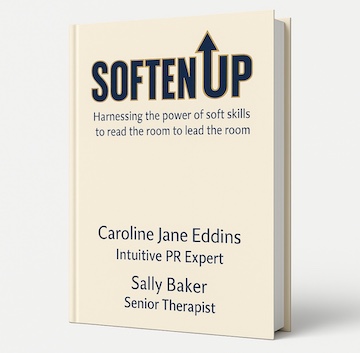 Soften Up, co-authored with Caroline Jane Eddins, is built on that principle. It’s about harnessing the power of soft skills to navigate the hard realities of modern life. Whether you’re leading a team, repairing a relationship, or simply trying to stay grounded when the world feels adversarial, the same truth applies: calmness is not weakness, and empathy is not surrender. They are, in fact, the foundations of genuine influence.
In the castle, clarity arrived too late for most of the players. In the rest of your life, you still have the chance to practise softening up and finding your natural authority.
 A free PDF of Soften Up hacks is available to download and start immediately practising. You’ll feel the powerful shift as you learn to read the room to lead the room. Scan the QR code on the right to ask any questions you may have about Soften Up, or to request the download.
You can also join the waitlist for the Soften Up book and additional free resources once they become available.

